
In Part 1 of this blog series, we discussed some common statistics of low back pain (LBP), as well some misconceptions regarding the cause of non-specific LBP
In this post, we will look at the most typical cause of non-specific LBP
One of the most important things to note regarding LBP, is that the low back is rarely the cause of the pain – it is simply where the pain ends up. How does it end up here? It generally starts with the hips. The gluteals, as we briefly touched on in Part 1 of this post, are the largest muscle group in the body, and are designed to absorb and generate large amounts of force. As such, if the glutes become inactive, or weak, then they will not be able to create the force that they are designed to, and something else generally must compensate. Before we look at that, let’s discuss reasons as to why the glutes might become weak, or inactive
1. Sitting: As you have likely heard, sitting for long periods of time in chairs, or at desks etc. is not great for you. One reason for this is that we do not need to stabilise or have any real muscle activity to hold a sitting position. As such, one of the first areas of the body to generally suffer, is the hips. In a seated position, our psoas (hip flexors) are short, and our gluteals are long and inactive. Sitting for long periods of time may well cause our hips to tighten and switch off.
2. Overuse: Whilst this might sound strange, overuse, or poor mechanics of the glutes, can cause tightness and inactivity. For example, if we are in the gym or performing physical activity often, and the glutes are not strong to begin with, there is only a certain amount of force that they can absorb. Eventually, if not managed, there will be so much tension in the glutes due to poor activation patterns, that they simply cannot absorb any more force and contract efficiently. As such, something else will suffer if we continue to be active and do not address the issue.
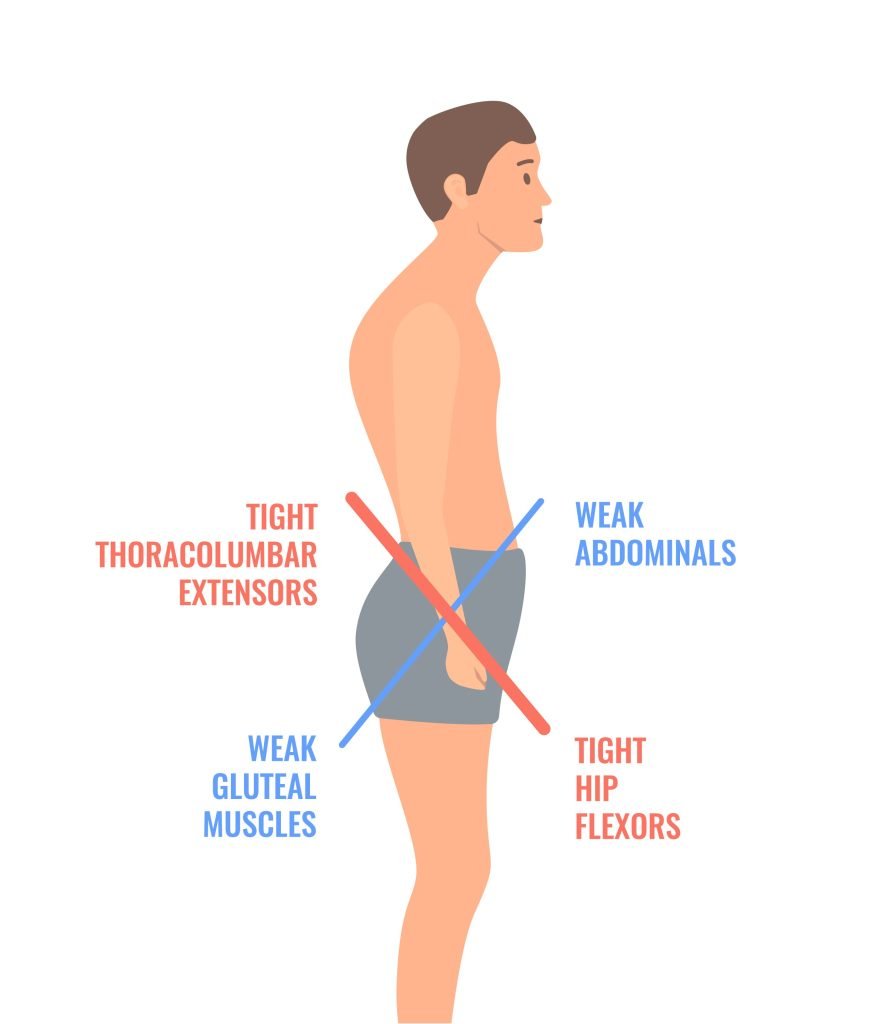
As mentioned before, when the glutes stop working as they should, something else must compensate. This could be the hamstrings (see Part 1 of this post), or, and we finally get to it, the low back, as these are the two directly connected muscle groups above and below the glutes. One more thing that can occur when the glutes become weak, is that their opposing muscle group, the hip flexors, can tighten. The hip flexors are the only muscles connecting the upper and lower body together directly. As such, when tight, the hip flexors will typically pull directly on the low back, as the primary hip flexor, the psoas, originates directly on the lower area of the spine.
The below image shows what can generally happen to the muscle groups, as well as posture, when LBP symptoms are present.
Now that we have looked at the typical cause of LBP, we are ready to discuss what we can do about it in Part 3 of this post
Recent Comments